
Four major vendors shipped meaningful updates to AI developer tools in the span of six weeks this summer. Anthropic released two new Claude models. OpenAI cut prices across its GPT-5.6 family. GitHub pushed more than a dozen changes to Copilot. Google added new controls to Gemini's managed agents. None of that happened quietly, and almost none of it made it out of the AI industry's own news cycle into a plain, sourced summary for engineers who just want to know what changed and whether it matters.
This roundup covers the AI developer tools news that actually affects how you build software right now: the model releases worth testing, the platform features worth turning on, and the survey data that explains why developer trust in these tools keeps slipping even as adoption climbs. Every figure below comes from a vendor's own announcement or Stack Overflow's Developer Survey, with a link back to the source.
The State of AI Developer Tools in 2025
Before getting into what shipped this month, it helps to know where developers actually stand on AI tools overall. Stack Overflow's 2025 Developer Survey, built on more than 49,000 responses from 177 countries, is the clearest independent read on that question, and it tells a two-sided story.
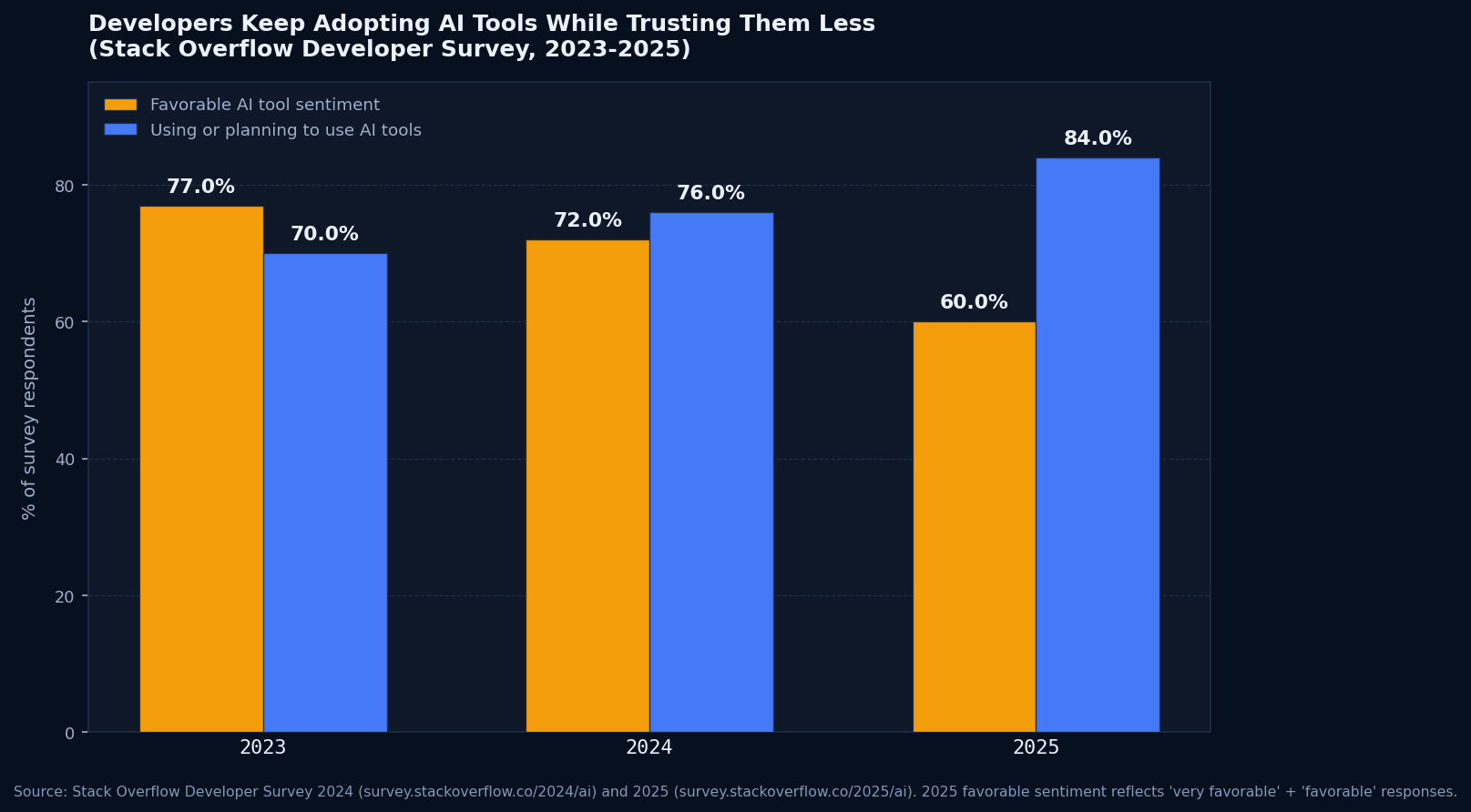
Usage keeps climbing. 84% of respondents are using or planning to use AI tools in their development process, up from 76% in 2024 and 70% in 2023. 51% of professional developers now use AI tools daily. Favorable sentiment, though, is moving the other way: only 60% of respondents describe their stance on AI tools as favorable or very favorable, down from 72% in 2024 and 77% in 2023, according to Stack Overflow's own year-over-year comparisons.
Trust in the output itself is thinner still. Just 33% of developers say they trust the accuracy of AI tool output, against 46% who actively distrust it, and only 3% say they highly trust it. Experienced developers are the most skeptical group in the survey, with the highest rate of high distrust of any experience bracket. The complaint developers raise most often, cited by 66%, is AI solutions that are almost right, but not quite, and 45% say debugging AI-generated code takes more time than debugging code a person wrote.
Agentic tools, the ones behind most of this month's Copilot and Gemini announcements, are further from mainstream than the coverage around them suggests. 52% of developers either avoid AI agents altogether or stick to simple autocomplete-style tools, and 38% have no plans to adopt agents at all. Among developers who do use agents at work, 70% say agents have cut the time spent on specific tasks, but only 17% say agents have improved collaboration within their team, the lowest-rated benefit measured in the survey.
This Month's Biggest AI Developer Tools News
With that backdrop, here is what actually shipped between late June and early August 2026, grouped by what it changes for a working engineer.
New models and price changes
Claude Opus 5 (Anthropic, Jul 24, 2026)
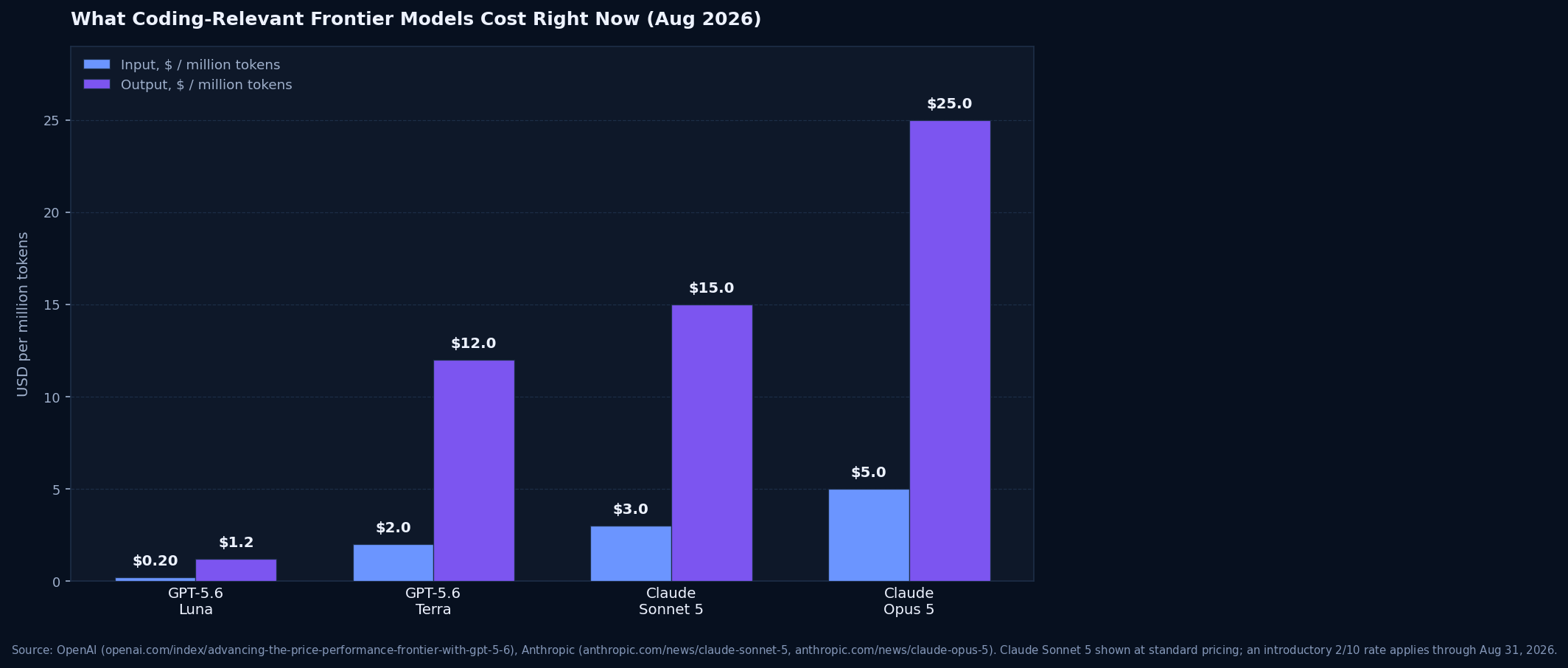
$5 / $25 per million tokens (input / output)Anthropic's new flagship model, priced the same as its predecessor Opus 4.8. Anthropic's own benchmarks put it ahead of every other model on Frontier-Bench v0.1, a coding-focused evaluation, and it is now the default model on Claude Max and the strongest option on Claude Pro.
Claude Sonnet 5 (Anthropic, Jun 30, 2026)
$3 / $15 standard ($2 / $10 intro through Aug 31, 2026)Anthropic's most agentic Sonnet model yet, built to close the gap with Opus-class performance at a lower price. It is the default model on Claude's Free and Pro plans and is available in Claude Code and on the Claude Platform.
GPT-5.6 price cuts (OpenAI, Jul 30, 2026)
Luna down 80% to $0.20 / $1.20; Terra down 20% to $2 / $12OpenAI cut API pricing across its GPT-5.6 family six days after launch, framing the move as a pass-through of efficiency gains in the models themselves. Both tiers are available in Codex, ChatGPT Work, and the API.
Copilot, code review, and agent platform updates
Customizable reasoning levels for Copilot cloud agent
GitHub, Aug 3, 2026You can now pick a reasoning level alongside the model when you hand a task to Copilot's cloud agent. A higher level can improve results on harder problems, but it spends more tokens and credits. Available on Copilot Pro, Pro+, Business, Enterprise, and Max.
Comment-triggered Copilot automations
GitHub, Aug 3, 2026Cloud agent automations can now trigger from an issue or pull request comment instead of only a schedule or label, for use cases like generating documentation from a PR comment or investigating a pasted stack trace. Business and Enterprise admins must enable the cloud agent policy first.
Agent skills and MCP for Copilot code review, GA
GitHub, Jul 29, 2026Copilot code review can now call your team's own tools and standards through a SKILL.md file under .github/skills, plus read-only MCP server connections for context like issue trackers. Moved from public preview (announced Jun 2, 2026) to general availability.
Gemini API Managed Agents: hooks and budget caps
Google, published Jul 28, 2026Managed agents now default to Gemini 3.6 Flash and add environment hooks that can block, lint, or audit a tool call inside the agent's sandbox. New budget controls cap token spend per task, scheduled triggers run agents on a cron schedule, and managed agents now work on free-tier projects.
GitHub also retired the Copilot Billing Preview app and announced the deprecation of GitHub Spark on github.com, both dated Aug 4, 2026, alongside the retirement of Gemini 2.5 Pro and Gemini 3 Flash as selectable Copilot models on Jul 31, 2026. Deprecations do not wait for you to notice them, so scan changelogs for retirement notices before you scan for new features.
Why This Round of Updates Matters More Than It Looks
Read individually, these look like routine release notes. Read together, they track directly back to the frustrations in Stack Overflow's survey data. Reasoning-level controls on Copilot cloud agent and Gemini's new budget caps both exist because agentic tasks can burn through tokens fast when a model over-thinks a simple problem, and cost is one of the practical reasons 38% of developers say they have no plans to adopt agents at all. Agent skills and MCP support for Copilot code review is a direct answer to the almost right, but not quite complaint that 66% of developers cite: it lets a review comment draw on a team's actual internal standards instead of generic pattern matching.
The bigger shift is procedural. Comment-triggered automations, agent skills, and environment hooks are all ways of giving an AI agent guardrails and context before it acts, rather than reviewing its output only after the fact. That is a reasonable response to a trust problem the survey data backs up. Developers are not skeptical of AI tools out of habit; 46% actively distrust the accuracy of the output they get back, and narrowing what an agent is allowed to do unattended is one of the few levers a platform vendor can pull that does not depend on the underlying model getting smarter.
How to Keep Up With AI Developer Tools News Without Wasting Your Week
Subscribe to the primary source, not a roundup
GitHub's changelog, Anthropic's newsroom, OpenAI's news page, and Google's developer blog all publish RSS feeds. A roundup written days later, including this one, is a starting point, not a substitute for the vendor's own release notes when you decide whether to act.
Filter for deprecations first
A new feature is optional. A model deprecation has a hard date attached, like the Gemini 2.5 Pro and Gemini 3 Flash retirement GitHub announced inside Copilot on Jul 31, 2026. Anything hardcoded to call a deprecated model breaks on schedule, so check changelogs for deprecation notices before anything else.
Test pricing changes against your actual usage
An 80% price cut on GPT-5.6 Luna sounds dramatic, but what matters is your blended cost across whichever tiers you actually call and how much of your traffic runs through each one. Pull your own usage logs before assuming a price cut changes your monthly bill by the same percentage.
Pilot new agent features on one repository first
Comment-triggered automations, reasoning-level controls, and agent skills all change what an agent is allowed to do unattended. Turn a new capability on for one active repository for a couple of weeks before rolling it out across every project.
Re-check vendor benchmark claims against your own code
Every benchmark comparing Claude Opus 5, Sonnet 5, and GPT-5.6 in this roundup came from the vendor that built the model being measured. That does not make the numbers wrong, but the only benchmark that should decide your default model is one you ran yourself against your own repository.
None of this changes a basic fact: shipping AI-generated or agent-assisted code faster does not make it production-ready by default. New reasoning controls, MCP context, and comment-triggered automations are useful additions to a development workflow, not a replacement for hardening what an agent ships before it reaches production.
If your team has already adopted several of these tools and the backlog of agent-generated changes nobody has fully reviewed keeps growing, that is exactly the gap we close at Prompt2Prod.AI. A focused production-readiness assessment turns a pile of agent-assisted changes into a prioritized, verified plan.